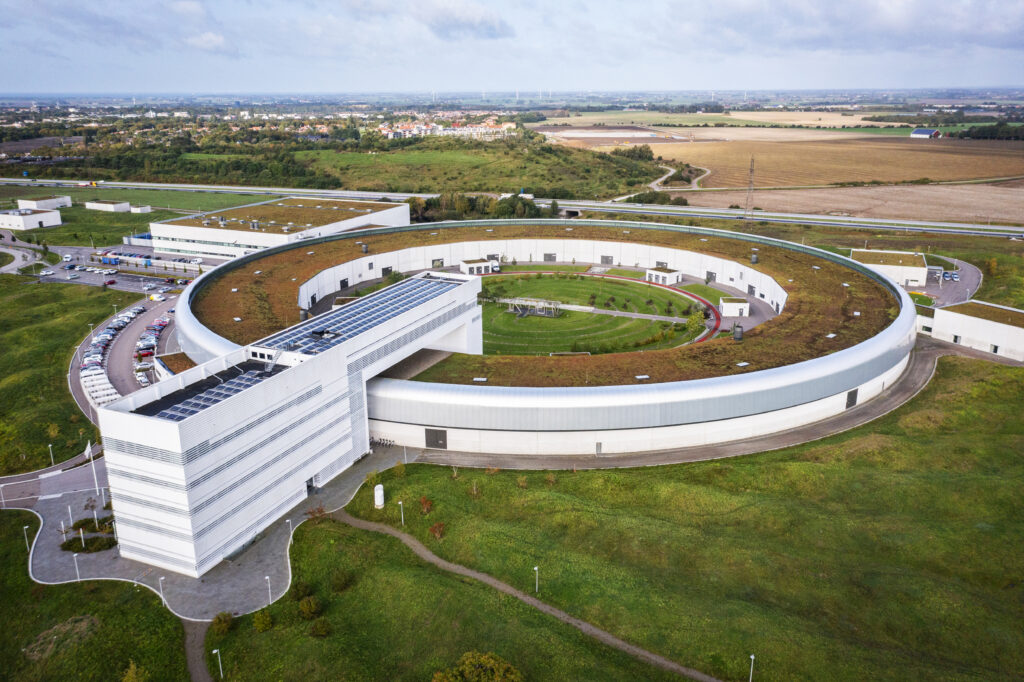
From experiment to insight: connecting three national research infrastructures
MAX IV, NAISS and InfraVis are combining data generation, high-performance computing and advanced visualization in a unique collaboration. By connecting their complementary capabilities, the three national research infrastructures strengthen Swedish research and enable more efficient use of national investments.
MAX IV generates large volumes of experimental data, but transforming these data into clear, interpretable results can be challenging. The collaboration therefore aims to create coherent workflows connecting experiments, computing, analysis and visualization. Guided tools and integrated services can reduce complex manual steps and help researchers move more efficiently from data acquisition to insight.
A key technical component is deeper integration between MAX IV and NAISS. The goal is to give MAX IV users transparent access to NAISS computing resources, allowing data to be processed during beamtime without being limited to the computing capacity available at MAX IV. Alongside this connection, visualization tools and user interfaces are being developed to help researchers explore results, assess data quality and interact with the integrated workflow.
“At MAX IV, we are always working to improve and extend our offer to users and become even more accessible. State-of-the-art tools for data visualisation and analysis are essential to achieving this goal. We are very excited about the collaboration,” says Mirjam Lindberg, technical director of MAX IV.
As Björn Alling, deputy director of NAISS, puts it:
”A seamless connection, from the perspective of scientists, of large data-generating experimental infrastructures on one hand and supercomputer and AI infrastructures on the other is the way forward. It will allow scaling up the scientific ambition level of research both in quality and quantity. NAISS is pleased that this vision is now being turned into practice here in Sweden together with MAX IV and InfraVis.”
The project also focuses on the user experience during experiments. Graphical tools for alignment and setup, together with interfaces for testing experimental parameters before data collection, could support earlier quality assessment and adjustments, helping researchers use beamtime more effectively. Continuous or near-real-time 3D reconstruction is another area of interest.
The collaboration also explores multimodal analysis and AI-supported methods for combining and interpreting complex data from different sources. Linking these approaches with NAISS computing resources and MAX IV data can extend existing analysis workflows and support new ways of working across the infrastructures.
“What makes this collaboration particularly valuable is that it connects national research infrastructures around the researchers’ full workflow, rather than treating data generation, computing, analysis and visualization as separate steps. By working together, we can make advanced resources easier to use and create greater value across the whole chain,” says Kajsa M Paulsson, Vice Director of InfraVis.
The project demonstrates the value of approaching national research infrastructures as a connected system. By linking MAX IV’s experimental capabilities, NAISS computing resources and InfraVis expertise in visualization and analysis, the collaboration connects technical infrastructure with researchers’ practical needs. Together, the three infrastructures strengthen the full chain from experiment to insight and enable work that would be difficult to achieve through any one infrastructure alone.
The NIM collaboration was initiated by InfraVis and is being carried out as one of its strategic projects. It builds on previous years development work between InfraVis and both MAX IV and NAISS. With MAX IV, the work has focused on strengthening data integration pipelines, bringing visualization and analysis closer to beamtime, and developing tools that make experimental data and research environments easier to explore. With NAISS, the focus has been on connecting visualization and analytical workflows with national high-performance computing and AI resources, making these capabilities more accessible and useful to researchers. The NIM collaboration brings these strands together, creating more coherent workflows across data generation, computing, analysis and visualization. In this way, InfraVis acts as an integrative layer between national research infrastructures, connecting technical capabilities with researchers’ practical needs.