
Darkness Matters
InfraVis User
Costanza Julia Bani
InfraVis Application Expert
Julius Häger (KTH)
InfraVis Node Coordinator
Björn Thuresson (KTH)
Tools & Skills
Godot, VR, QGIS
Keywords
VR, GIS
Background
Darkness Matters is a fulldome documentary and research project offering a meditative journey through natural darkness bringing awareness about the increasing issue of light pollution. Costanza Julia Bani contacted InfraVis with the goal of bringing a future perspective on the light pollution issue.
The Project
The InfraVis project was defined in two parts. The first part was to calculate current and future light pollution levels for the locations featured in the movie, and the second being to integrate this data into an interactive VR experience where the user could look at how these locations might look with future light pollution levels.
To calculate the light pollution, or skyglow, for the locations in the movie we used NASAs Skyglow Estimation Toolbox (SET) which can calculate hemispherical skyglow maps from satellite light data. For the satellite data we used the Earth Observation Group’s VIIRS Nighttime Lights (VNL) dataset. The VNL dataset contains a high detail global map of nighttime lights, many gigabytes in size, which needed to be cropped for SET to be able to work with. For this QGIS was used to extract nighttime light satellite images containing only the 400 km kilometer around the location of interest, which could then be used to calculate skyglow maps.
These skyglow maps were then imported in the game engine Godot, together with stills from the movie from these locations. For each still a “skymask” was authored which allowed separating the sky from the rest of the sky. This mask together with the skyglow map then allowed us to extrapolate the future light pollution levels from current light pollution trends. Ambience from each scene was also looped and imported to play in the background for each scene.
This allows the user to interactively explore the impact of future light pollution on these landscapes and animals.
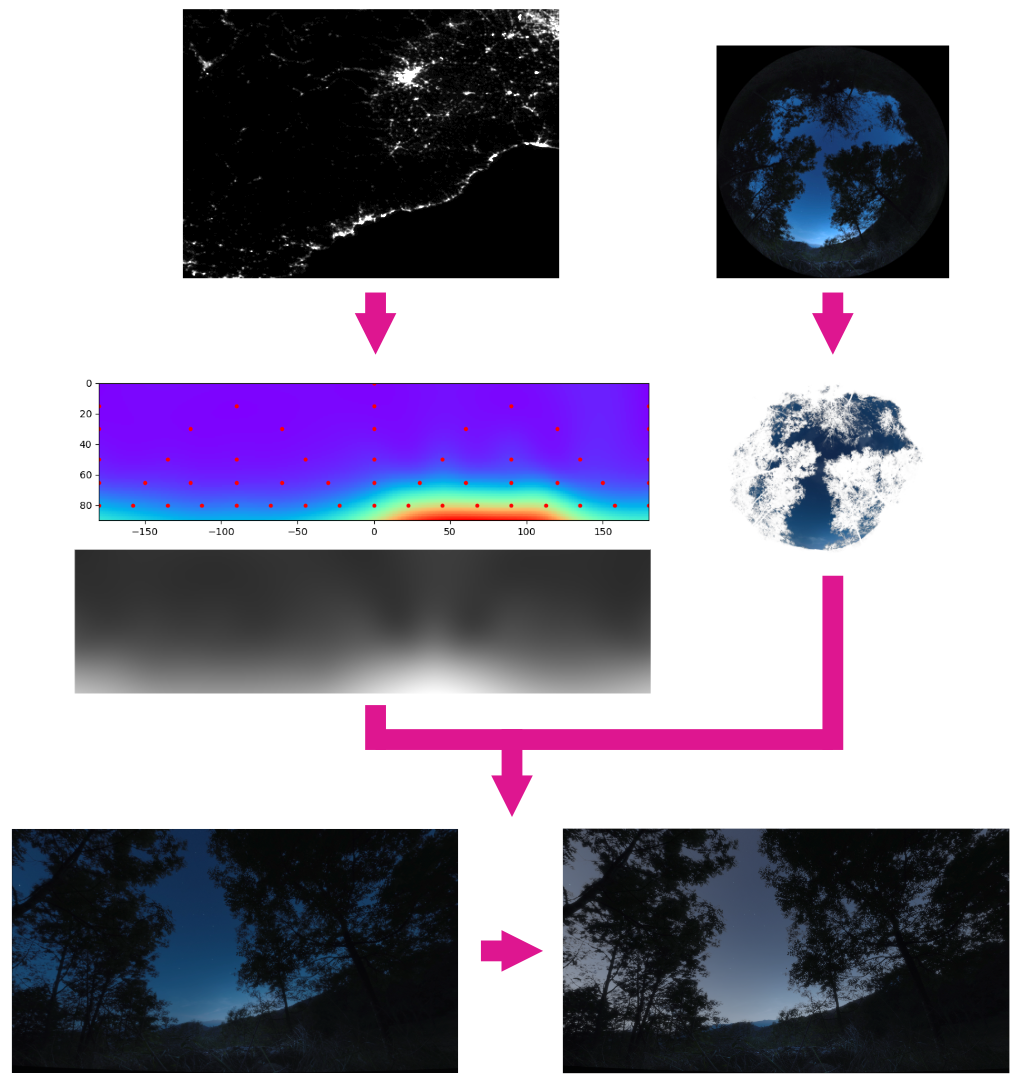
The data pipeline for the Darkness Matters VR application. Left column: satellite data is processed using SET and converted to a skyglow map. Right column: Stills from the movie are masked to be able to separate the sky. Botttom: The skyglow map applied to the scene.